
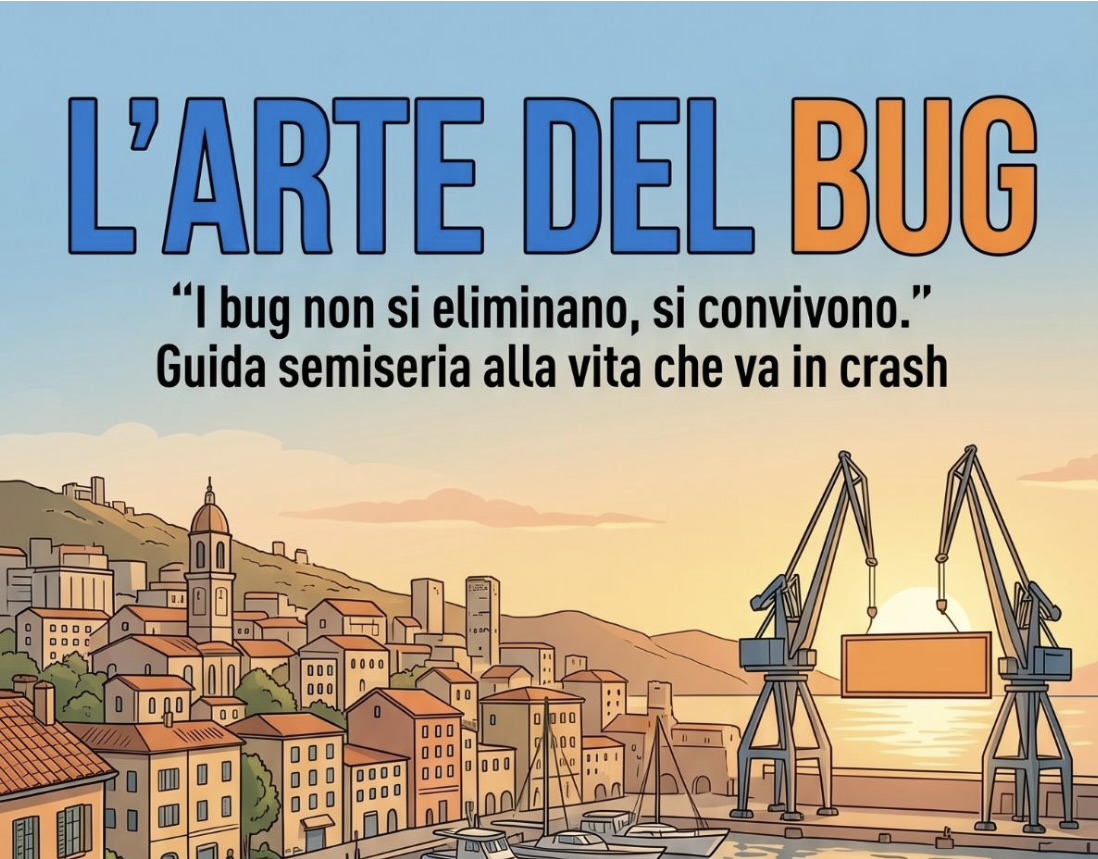
Imagine a book that takes software bugs — those errors every programmer knows all too well — and turns them into a lens for looking at life. Not a technical manual, not a self-help essay, but something far rarer: a witty, well-read, and surprisingly profound work, distributed for free by an author who clearly knows both code and life.
The Art of the Bug by Andrea Salis is exactly that.
What it's really about
A bug isn't just a program error. It's the Monday morning that refuses to come, the moka pot that decides not to brew, the traffic gone insane in the rain, the paycheck that arrives whenever it pleases. It's the love of your life choosing 11:59 PM on your birthday to send you a laconic, devastating "We need to talk."
The book explores — through a lens that blends Dante, Kafka, Garzoni, Boccaccio, and Tobino — the idea that system errors cannot be eliminated: you learn to live with them.
From the preface:
> "Bugs are not eliminated. They are endured, worked around, accepted with the smile of the defeated. Sometimes, if you are crazy enough, they are even loved."
Each chapter is a "cell" — an explicit nod to Tommaso Garzoni's L'ospitale de' pazzi incurabili (The Hospital of Incurable Madmen, 1586) — and stages a different everyday bug, populated by characters who seem to have stepped out of a coming-of-age novel that never quite made it.
The chapters
The Monday Morning Bug is the first and perhaps most universal: the alarm that rings with the grace of a nuclear attack siren, the moka pot that produces only steam, the school drop-off traffic where parents resemble infantry troops sent to the front, the rain that turns sidewalks into harbor docks. Then the bus that never comes, the transit strike announced with surgical coldness, car horns becoming a polyphony of urban frustration. The chapter closes with a striking declaration: Monday isn't a day, it's an eternal bug, an infinite loop from which it's constitutionally impossible to emerge sane.
The Unbearable Bug of the Paycheck tells the story of Lorenzo, an office worker who records purchase invoices on obsolete management software and counts the days until his salary — which unfailingly arrives ten days late. One day, with a 99.5°F fever, he calls in sick but ends up — through a database error in reality itself — on the stage of the company conference as the keynote speaker, with a "SPEAKER" badge printed by mistake. His improvised speech about the sea as a metaphor for modern work earns a standing ovation, and he's proposed as "Global Head of Spiritual Innovation and System Crash Management."
The Golden Flyer is the story of the Knight of the Traffic Light, the only driver who still stops at red in an urban jungle where everyone runs them. While he waits dutifully, souped-up scooters and SUVs zoom by, smartphone-glued pedestrians cross without looking, elderly ladies with shopping carts bend spacetime, and zen cyclists cut through traffic convinced karma will protect them. His reward for civic virtue? A supermarket flyer. The ending, written as a Boccaccio-style novella, is among the book's finest pages.
The Zipper Bug and the Sin of the Housewives reads like something straight out of the Decameron: a bus driver falls from his vehicle when the rusted door hinge gives way in his sleep, and discovers that his wife and the village's devout housewives run a secret brothel among the olive trees. Right after, the traffic warden's wife cheats on him with a gym trainer, and he chases them through the alleys with his service pistol and beer-soaked uniform. Two tiny material bugs — a hinge and two pints of beer — dismantle the respectability of an entire town.
The Bug of the Secret Group is a savage satire of digital cheating in the age of social networks. Ernesto, convinced he's operating like a Machiavellian prince in the world of secret chat groups, leaves digital traces everywhere: he heart-comments on strangers' photos while the algorithm suggests them to his wife, starts live streams thinking they're private video calls, and turns his secrecy into an erotic rally in the town square. Machiavelli, the author notes, would update his manual: "Men forget the death of their father more easily than the loss of their inheritance — and they forget the theft of an entire kingdom more easily than a compromising screenshot sent to the wrong group."
The Photographer with No Photos is perhaps the most hilarious chapter. Lorenzo, a professional photographer convinced he's a visual genius, takes on the most important wedding of his career: a demanding bride, an irascible groom, a priest blessing a laptop — and he forgets to insert the memory card into his reflex camera. An entire wedding day captured only in the camera's volatile firmware cache, zero photos saved. The finale on the beach, with the groom chasing the photographer through the umbrellas and the bride falling head over heels revealing her lack of underwear, is pure slapstick gold.
The Writer Without Readers closes the book with a satire of the pay-to-publish literary world. An aspiring writer churning out four books a year — historical novels where Garibaldi dines with Cleopatra, dinosaurs in togas voting on agrarian reform in the Roman Senate — gets fleeced by a "strategic editorial consultant" who turns every mistake into billable gold. Book launches in deserted basement rooms, fair booths set up on camping tables, paid interviews on local radio stations with an audience of seven insomniac grandparents and their respective cats.
Standing on the shoulders of giants
One of the book's most interesting features is the opening bibliographical note, where Salis openly declares his sources: from Tommaso Garzoni (The Hospital of Incurable Madmen, 1586) to Mario Tobino (The Free Women of Magliano, 1953), from Dante to Kafka, from Erasmus of Rotterdam to Boccaccio. The book doesn't hide its influences: it embraces them and rereads them through a modern lens, proving that life's bugs were catalogued long before Silicon Valley coined the term.
> "These sources aren't meant to make the book more serious or academic. They're just here to remind you that I didn't invent bugs during a sleepless night. They're part of a very long, glorious literary and human tradition — I just updated the operating system."
The author
Andrea Salis (Genoa, 1973) isn't a writer who pretends to be a programmer — he's a programmer who writes, and it shows. With over twenty years of experience in IT, he's worked at Siemens SPA, Sun-Times Srl (eight years), helped launch a company that grew to over 3000 clients in three years, and currently works at For J S.r.l. , a growing company in La Spezia.
Alongside his career, he's pursuing two university degrees: Humanistic Informatics at the University of Pisa and Web Community Management at Unitelma La Sapienza in Rome (where he earned 102/110 and is completing his experimental thesis). He's been an active Wikipedia contributor (technical content), founded the photography community fotoart.org (2004–2023, over 10,000 members), and has been a restaurateur, photographer, and — as he puts it — "a relentless commuter for love of the stands" of Genoa CFC.
On his website salisnet.eu he writes about the web, development, photography, and technology with the same direct, ironic tone that fills this book.
What strikes you about Salis is that he isn't looking at the tech world from the outside: he's been living in it since the web was made of 56k modems and ASP pages. And perhaps that's exactly why he can afford to laugh at it — because he knows every corner of the code, every possible system failure, and knows that some things you either take with irony or they leave a mark.
Why read it
In a world where everyone is trying to sell you quick fixes, miracle patches, and five-step guides to happiness, The Art of the Bug does the exact opposite: it tells you that bugs don't get solved — they get accepted. That life never compiles on the first try. And that the only sensible answer to chaos is a good laugh.
It's not a self-help book. It's not a programming manual. It's not a novel. Maybe it's a bit of all three. Or maybe — as the author writes in the preface — it's a bug that works perfectly.
Download it, read it, and next time your code crashes, remember: it's just life trying to be friendly.
Download the ebook
The ebook is distributed for free in PDF format. No registration, no cost, no tricks.
Download The Art of the Bug (PDF)
Happy reading. And if you find a bug, keep it close.